

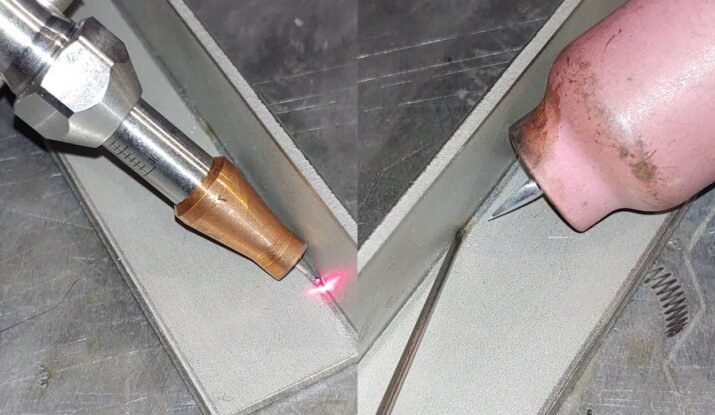
Comparing laser welding vs TIG and MIG comes down mostly to thickness. Handheld fiber laser welding fits thin stainless steel, carbon steel and aluminium, roughly 0.5 to 4 mm, where distortion and grinding are eating your time. MIG is still the better process for thick structural sections and joints with poor fit-up. TIG remains the choice for critical root passes and fine, low-volume precision work. Many fabrication shops end up running all three.
The sales pitch for handheld laser welders usually arrives as one number: up to four times faster than TIG. That figure comes from the people selling the machines. On the right job it can hold up. On the wrong job, a laser welder is an expensive way to make a weld you could have made with equipment you already own.
How each process puts heat into the metal
MIG feeds wire continuously through the gun, and the arc melts that wire into the joint. It lays down a lot of metal quickly, which is why it is so common in structural fabrication, but it brings spatter and a wide band of heat into the surrounding steel.
TIG uses a tungsten electrode with filler rod fed by hand. It is slow, it takes two hands and often a foot pedal, and in skilled hands it produces some of the cleanest welds there are.
A fiber laser focuses its energy into a spot a fraction of a millimetre wide. The weld is narrow and the heat stays where you put it. Miller, which sells laser, TIG and MIG equipment, reports that on 18 gauge carbon steel, about 1.2 mm, laser welding puts in roughly half the total heat that TIG or MIG would put into the same part. Less heat means less warping, less discolouration and less straightening afterwards.
Laser welding vs TIG vs MIG side by side
| Factor | Handheld fiber laser | TIG | MIG |
| Where it is strongest | Thin sheet, about 0.5 to 4 mm | Thin to medium, precision and root passes | Medium to thick, about 3 mm upward |
| Heat input | Lowest | High | Medium to high |
| Distortion on thin sheet | Minimal | Significant without fixtures | Significant |
| Travel speed on thin sheet | Fastest | Slowest | Fast |
| Cleanup after welding | Light, faint heat tint | Clean bead, heat tint on stainless | Spatter and grinding |
| Joint gap tolerance | Tight fit-up needed | Forgiving with filler | Most forgiving |
| Learning curve for basic work | Short | Longest | Moderate |
| Equipment cost | Highest | Low | Low to moderate |
| Main hazard | Class 4 laser beam and reflections | Arc UV | Arc UV and fumes |
Where laser welding pays for itself
The real saving rarely shows up at the torch. It shows up after welding. On thin stainless enclosures, kitchen equipment, cabinets, railings and aluminium panels, a TIG or MIG weld often needs grinding, polishing and sometimes straightening before the part can ship. A laser weld on the same part usually needs a wipe and a light finish.
So before you look at travel speed, look at your grinding hours. If two people spend most of the day cleaning up thin-sheet welds, laser welding has a strong case. If the grinders are mostly idle, the case is weaker than the brochure suggests. Our article on how laser welding machines improve production efficiency goes further into the throughput side.
Where MIG and TIG still win
Thick plate. Most handheld laser welders in the 1.5 to 2 kW range are aimed at sheet up to about 4 mm in a single pass. Once you are into heavy structural plate and penetration is what matters, MIG is faster and far cheaper per metre of weld.
Poor fit-up. A laser needs tight joint gaps. Wire feed attachments help, but MIG is still more forgiving when parts do not sit perfectly.
Coded work. If a job runs under a qualified welding procedure, changing the process means requalifying it. Pipe root passes and pressure work done to a code usually stay with TIG until a laser procedure has actually been qualified.
Outdoor site work. Wind, dust and awkward access all favour the arc processes.
What switching really costs
The machine is the obvious cost. These are the ones that are easy to miss:
- The water chiller. In a UAE workshop that reaches 40°C in summer it needs shade, airflow and a rated ambient temperature that matches your conditions.
- Shielding gas, normally argon or nitrogen.
- Protective lenses in the welding head, which wear out and need replacing.
- A controlled laser area, because handheld units are class 4 lasers that can injure eyes through reflected light.
- Safety eyewear rated for the laser’s wavelength, around 1,070 nm for fiber lasers, for everyone in that area.
- Basic laser welding is quicker to learn than TIG, but parameters and joint prep still have to be taught.
Joint cleanliness also matters more with a laser. Oil, mill scale and oxide all show up in the weld, which is one reason shops often buy a laser cleaner alongside a laser welder. Our comparison of laser cleaning vs sandblasting covers that side.
A practical way to decide
Pull last month’s jobs and sort them by material and thickness. If most of your work is under 4 mm and the finish matters, arrange a trial on your own parts, not the supplier’s demo pieces. Ask for sample welds on your material and joint types, and time the whole job including cleanup. If you are looking at our Fanuci laser welding machines, such as the FANUCI 5.0 PRO GenX, send us your material and joint details first. If most of your work is thick structural steel, keep your MIG sets and let someone else pay for the speed claim.
Frequently asked questions
Is laser welding stronger than TIG welding?
Not inherently. A properly made weld from either process can meet the joint’s requirements. Strength comes from joint design, fit-up and parameters, and the main advantage of laser welding is lower heat and distortion rather than raw strength.
Can a handheld laser welder weld thick steel?
Most 1.5 to 2 kW handheld units are aimed at sheet up to about 4 mm per pass. Thicker sections need multiple passes, higher power or, more often, MIG.
Is laser welding easier to learn than TIG?
For basic work, generally yes. Consistent results still depend on joint preparation, fit-up and choosing the right parameters.
Does laser welding need shielding gas?
Yes. Argon or nitrogen is normally used to protect the weld pool and keep the bead clean.
Can laser welding replace MIG in a fabrication shop?
On thin-sheet work it can take over a large share of jobs. On thick structural steel it usually sits alongside MIG rather than replacing it.