

| Quick answer
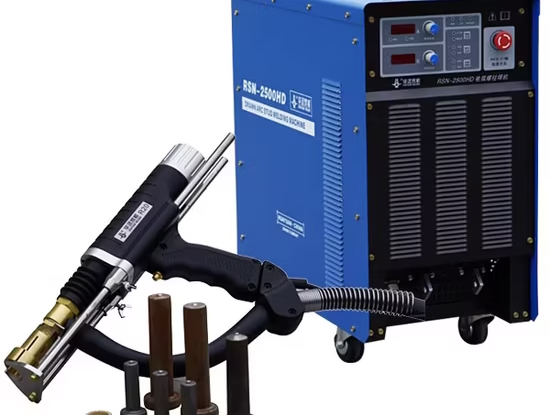
Use drawn arc stud welding for studs from about 8 mm up, on plate 2 mm and thicker, where strength matters more than appearance. Use capacitor discharge (CD) welding for small studs up to about 10 mm on thin sheet, where the reverse side has to stay clean. Most structural work in the Gulf runs drawn arc. Most sheet metal, signage and stainless fabrication runs CD. |
Both processes weld a stud to a base metal in under a second, and that is where the similarity ends. They use different power sources, different studs, different setup and they fail in different ways when used on the wrong job. Picking between them comes down to three questions: how big is the stud, how thick is the base metal, and does anyone care what the back of the panel looks like.
How drawn arc stud welding works
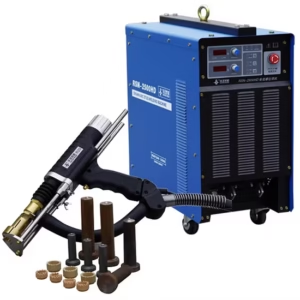
The gun lifts the stud off the workpiece and draws an arc between the two. The arc melts the stud end and a pool on the plate, then the gun plunges the stud into that pool. A ceramic ferrule sits around the joint the whole time, shielding the weld and shaping the fillet that squeezes out around the base. The cycle runs from roughly 100 milliseconds for small studs to around a second for 25 mm shear connectors.
The result is a full cross-section weld that is stronger than the stud itself. Do a bend test on a good drawn arc weld and the stud bends; the weld does not let go. That is why every composite deck, every anchor plate and most shipyard insulation work runs on this process.
How CD stud welding works
CD studs carry a small ignition tip on the weld end. A capacitor bank dumps its charge through that tip, the tip vaporises, an arc flashes across the full face, and spring pressure closes the joint. The whole event takes a few milliseconds. No ferrule, almost no heat into the sheet, and, on material as thin as 0.5 mm, no mark on the reverse.
That last point is the reason CD exists. Kitchen equipment, electrical enclosures, cladding panels, signage letters: anything where the back face is visible or painted gets CD studs. The limit is size. Past about 10 mm diameter the capacitor bank cannot deliver enough energy, and drawn arc takes over.
The decision table
| Factor | Drawn arc | Capacitor discharge (CD) |
| Stud diameter | 3 to 25 mm | 2 to 10 mm |
| Base metal thickness | 2 mm and up; at least 1/4 of stud diameter for full strength | From 0.5 mm sheet |
| Cycle time | 100 to 1,000 ms | 1 to 6 ms |
| Reverse side marking | Possible on thinner plate | None on typical sheet |
| Ferrule | Required (ceramic) | Not used |
| Materials | Mild steel, stainless; aluminium with shielding gas | Mild steel, stainless, aluminium, some brass |
| Power source | Transformer or generator, high current | Portable capacitor unit, standard socket |
| Typical work | Shear connectors, anchors, structural attachments | Sheet metal, enclosures, signage, catering equipment |
Where each one earns its keep
Drawn arc owns structural work. Welding 19 mm shear connectors through metal decking onto beams is a drawn arc job, full stop. So are anchor studs on embed plates and pins holding insulation on tank shells and ship hulls.
CD owns fabrication shops. A stainless counter with threaded studs on the underside, an aluminium sign with mounting pins, a control panel with earth studs: all CD, all day, because nobody wants to regrind and repolish the show face.
What it means for equipment
Drawn arc rigs are a commitment. The power source is heavy, it wants a generator or serious mains supply on site, and the cables alone need a vehicle. If the requirement is one composite deck project rather than a permanent capability, renting the rig usually beats buying it; our stud welding rental page covers what comes in the package. CD units go the other way: most are one-person portable and run off a normal socket, which is why small fabricators tend to buy rather than rent them.
Mistakes we keep seeing on site
- Welding over mill scale, paint or heavy zinc. Both processes want bright metal at the weld spot. Thirty seconds with a grinder saves a failed pull test.
- Damp ferrules on drawn arc work. Ceramic ferrules absorb moisture overnight, and damp ferrules cause porosity. Store them sealed, especially in coastal humidity.
- Skipping the shift-start bend test. Settings drift, cables wear, and the first anyone hears of it is a stud snapping off in service.
- Using CD studs in a drawn arc gun or the reverse. The weld ends are engineered differently and the processes are not interchangeable.
FAQ
Q: Can CD welding be used on galvanized sheet?
Not reliably. The zinc contaminates the weld in the few milliseconds available. Grind the spot clean or move to drawn arc.
Q: Can drawn arc run on 1 mm sheet?
No. It puts real heat into the base metal and burns through. Keep base metal at a quarter of the stud diameter or more.
Q: Do both processes need bend testing?
Yes. First studs of each shift and after any setting change, bent to roughly 30 degrees. Visual check of a full 360-degree flash comes first.
Q: Which studs does each accept?
Drawn arc: shear connectors, threaded and plain studs, insulation pins, 3 to 25 mm. CD: threaded and plain studs up to about 10 mm with the ignition tip. Not interchangeable.