

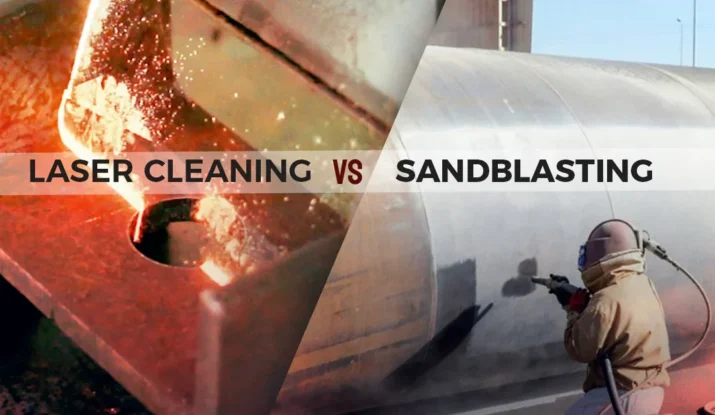
Laser cleaning vs sandblasting is not a contest one side wins every time. Laser cleaning removes rust, paint and oil with no abrasive media, no spent grit and very little effect on the metal underneath, which makes it the better choice for weld prep, moulds, in-plant maintenance and parts you want to keep. Sandblasting is cheaper to start, faster on large heavily coated areas, and creates the rough anchor profile that many thick protective coatings are specified to bond to.
Sandblasting has been the default for so long that most people never question it. Then someone shares a video of a laser stripping rust off a steel plate in a single pass, and the question becomes whether to switch. Both methods work. They work best on different jobs, and picking the wrong one costs money either way.
How each method removes the surface
Blasting fires abrasive particles at the surface with compressed air. Grit, garnet, steel shot or sand chip away the coating and roughen the steel at the same time. It is fast and it is crude, in the useful sense of the word.
A laser cleaner sweeps a beam across the surface. The rust, paint or oil absorbs the energy and vaporises or breaks away, while the clean metal underneath absorbs far less of it. Nothing touches the part and nothing is thrown at it.
Laser cleaning vs sandblasting side by side
| Factor | Laser cleaning | Sandblasting |
| Consumables | Electricity and protective lenses | Abrasive media, used continuously |
| Waste | Fume and fine dust, captured by extraction | Spent media mixed with the removed coating |
| Effect on base metal | Minimal at correct settings | Roughens and removes some metal |
| Anchor profile for coatings | Limited | Created by design |
| Speed on large, thick coatings | Slower, unless high power continuous wave | Fast |
| Selectivity | Can clean a narrow band and leave the rest | Needs masking |
| Up-front cost | High | Low |
| Running cost | Low | Media, compressed air, disposal, cleanup |
| Noise | Low | High |
| Near running equipment | Practical with fume extraction | Usually means shutdown and masking |
Where laser cleaning clearly wins
Inside a working plant. Blasting near pumps, motors, gearboxes or hydraulics puts grit where it should never go, so production stops and everything gets masked and sheeted. A laser cleaner can work beside running equipment with fume extraction and a controlled laser area around the operator.
Weld preparation and post-weld cleaning. Mill scale comes off before welding and heat tint comes off afterwards, especially on stainless, without grinding into the base metal.
Moulds, tooling and precision parts, where any change to the surface counts as damage.
Selective cleaning. You can strip a 50 mm band along a weld line and leave the paint either side untouched. Blasting would need careful masking to do the same.
Recurring maintenance. When the same equipment gets cleaned every month, having no media to buy, store and dispose of adds up quickly.
Where sandblasting is still the right call
Large areas with thick, old coatings. Tank exteriors, structural steel and hulls carrying several coats of paint are where blasting covers the most ground per dirham. High power continuous wave lasers close some of that gap, at a much higher machine price.
Coating specs that call for an anchor profile. Protective coating systems often specify both a cleanliness grade, such as Sa 2½ under ISO 8501-1, and a surface roughness assessed under ISO 8503. Blasting produces that roughness by design. Laser cleaning reaches high cleanliness, and published research on laser-prepared steel shows promising coating adhesion, but it does not roughen steel the same way. Even some laser manufacturers acknowledge that when a coating needs a roughened anchor profile, blasting is cheap and effective. If the coating datasheet asks for a profile, check with the coating manufacturer before you change the prep method.
Occasional one-off jobs. If you clean something big once a year, hiring a blasting contractor almost always beats buying a laser.
What it really costs
Blasting looks cheap because the equipment is cheap. The running costs sit elsewhere: abrasive media, compressor fuel or power, containment sheeting, disposal of spent media mixed with old paint, the cleanup afterwards, and the downtime around all of it.
Laser cleaning turns that around. The machine costs considerably more at the start, and the running costs are mainly electricity, protective lenses and extraction filters. The arithmetic favours the laser when cleaning is frequent and repetitive, and favours blasting when it is rare and large.
Pulsed or continuous wave laser cleaning
Laser cleaners come in two broad types. Pulsed lasers fire very short bursts of energy with pauses in between. They put little heat into the part, so they suit thin metal, moulds, delicate surfaces and light contamination, but they are slower and cost more per watt.
Continuous wave lasers put out a steady beam at higher power. They strip heavy rust and paint from thick steel quickly, but they put more heat into the part, which can discolour or warp thin sheet. Match the type to the work you do most often, not to the most impressive demo video. Before you buy, ask which type a machine is. You can see the Fanuci Futura laser cleaning machine and our laser cleaning machines in the UAE.
Safety on both sides
Handheld laser cleaners are class 4 lasers. They need a controlled work area, eyewear rated for the laser’s wavelength and proper fume extraction, because the removed coating becomes airborne. Old paints can contain lead or chromates, so treat the fume as hazardous until you know otherwise.
Blasting has its own list: respiratory protection, noise, dust containment, and the silicosis risk from crystalline silica when silica sand is used. Many contractors and specifications have moved away from silica sand for exactly that reason.
If the surface you are cleaning is going back into service with new fasteners, our guide to fastener coatings for oil and gas covers what to specify.
Frequently asked questions
Is laser cleaning better than sandblasting?
For regular, precise or in-plant cleaning, usually yes. For large areas with thick coatings, or where a coating needs a rough anchor profile, sandblasting is often still the better and cheaper choice.
Does laser cleaning damage the base metal?
At the right settings the effect on the metal is minimal. Too much power, particularly from a continuous wave laser on thin sheet, can discolour or distort the part.
Can a laser remove thick paint?
Yes, but more slowly than light rust. Thick coatings may need several passes or a high power continuous wave machine.
Is laser cleaning good preparation for painting?
It leaves a very clean surface. Whether it meets a coating specification depends on whether that specification requires a surface roughness profile, so check the coating datasheet.
Does laser cleaning produce fumes?
Yes. The removed rust and coating become airborne particles and gases, so fume extraction is needed, especially when stripping old paint.