

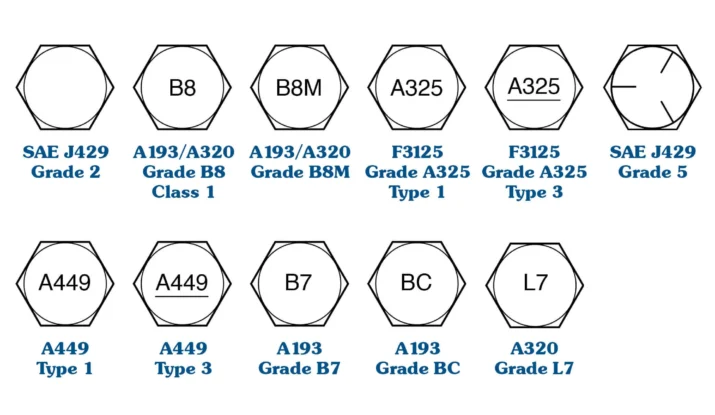
Bolt grades are the two numbers stamped on the head of a metric bolt, and together they tell you how strong it is. Multiply the first number by 100 to get the nominal tensile strength in MPa. The second number tells you what fraction of that the bolt can carry before it starts to stretch permanently. So 8.8 means about 800 MPa tensile and 640 MPa yield, 10.9 means about 1,000 and 900, and 12.9 about 1,200 and 1,080. Higher is stronger. It is not always better.
Pick up a bolt from any site container and look at the head. Most people on site never do. That marking is the only thing on the part that tells you whether it belongs in the joint, and it takes two seconds to read.
How to read a bolt grade marking
The system comes from ISO 898-1, the standard for carbon and alloy steel bolts. Take 10.9 as the example.
- The first number, 10, times 100 gives 1,000 MPa nominal tensile strength. That is roughly the stress at which the bolt breaks.
- The second number, 9, means the yield point sits at 90% of that, so about 900 MPa. Yield is where the bolt stops springing back and starts to stretch for good.
The second number matters more than people think. The gap between yield and breaking is your warning. An 8.8 bolt yields at 80% of its tensile strength, so it has room to stretch and show distress before it fails. A 12.9 yields at 90%, which leaves a much thinner margin between bending and breaking.
Bolt grades compared: strength chart
| Grade | Nominal tensile (MPa) | Minimum tensile (MPa) | Minimum yield (MPa) | Typical use |
| 4.6 | 400 | 400 | 240 | Light fixings and brackets, non-structural |
| 5.8 | 500 | 520 | 420 | General engineering, low loads |
| 8.8 (up to M16) | 800 | 800 | 640 | Structural steelwork, machinery |
| 8.8 (above M16) | 800 | 830 | 660 | Structural steelwork, machinery |
| 10.9 | 1,000 | 1,040 | 940 | Preloaded joints, heavy machinery, crane bases |
| 12.9 | 1,200 | 1,220 | 1,100 | Socket cap screws, dies, high stress machine parts |
These are minimum values from ISO 898-1. The nominal figure is just the label. The minimum is what a bolt has to prove in testing, which is why 8.8 bolts above M16 carry slightly higher minimums than the smaller sizes. It is also why the quick calculation earlier gives 900 MPa yield for 10.9 while the table shows 940: the calculation gives the nominal figure, and the standard sets the tested minimum a little higher.
Why 8.8 is the default on Gulf projects
Open the structural drawings for a typical steel building in the UAE and most of the bolts will be 8.8. It is strong enough for the great majority of connections, it is stocked everywhere, it hot dip galvanizes without drama, and it is ductile enough to give warning before it fails.
A stronger bolt does not make a connection stronger if something else in the joint gives way first. When the plate, the weld or the bolt hole is the weak point, upgrading from 8.8 to 10.9 only adds cost. That call belongs to the structural engineer, not the purchasing desk.
When 10.9 earns its price
A 10.9 bolt carries roughly 25 to 30% more tensile load than an 8.8 of the same diameter, depending on size. That matters when you need high clamping force from a limited number of bolts: preloaded connections, crane rails, heavy machinery bases and joints that see repeated or vibrating loads.
The catch is coating. 10.9 can be hot dip galvanized only under controlled processing with testing, because high strength steel is more sensitive to hydrogen picked up during acid pickling. Zinc flake coatings avoid that risk and are the common choice. We go through the options in our guide to fastener coatings for oil and gas.
Where 12.9 belongs, and where it does not
12.9 is the grade you find in socket head cap screws, press tools, dies and high stress machine parts. It is very strong and very hard.
It is also the grade you should not hot dip galvanize. A minimum tensile strength of 1,220 MPa puts it well inside the range where hydrogen embrittlement becomes a real risk, and that kind of failure is delayed and sudden. Outdoors, 12.9 parts are usually zinc flake coated or kept painted and maintained. If someone offers 12.9 as an upgrade for structural steelwork, ask what problem it is meant to solve.
Match the nut and washer to the bolt
A bolt grade only holds if the nut keeps up. The rule is simple: the nut’s property class matches the bolt’s first number. Class 8 nuts go with 8.8 bolts, class 10 with 10.9, class 12 with 12.9. Put a soft nut on a hard bolt and the threads strip before the bolt reaches its preload.
For high strength preloaded bolts, use hardened washers under whichever part gets turned, so the nut or head does not dig into the steel and lose clamping force. When you order DIN 934 hex nuts, state the property class so it matches the bolt. Our DIN 931 vs DIN 933 guide covers the bolt shapes themselves.
A325 and A490: the American equivalents
Projects designed to American codes call for A325 and A490 structural bolts instead. Since 2016 both have been grades within a single standard, ASTM F3125, rather than standards of their own.
| Grade | Minimum tensile | Minimum yield | Hot dip galvanizing | Close to |
| F3125 Grade A325 | 120 ksi (about 830 MPa) | 92 ksi (about 635 MPa) | Permitted | 8.8 |
| F3125 Grade A490 | 150 to 173 ksi (about 1,040 to 1,190 MPa) | 130 ksi (about 895 MPa) | Not permitted | 10.9 |
In strength terms A325 sits close to 8.8 and A490 close to 10.9. They are not drop-in swaps, though. They are heavy hex structural bolts made to their own dimensions, in inch sizes or as the metric A325M and A490M, so they do not interchange one for one with DIN or ISO bolts. A490 also cannot be hot dip or mechanically galvanized under F3125. Zinc-aluminium flake coatings are approved for it instead. Both are normally paired with ASTM F436 hardened washers. For A325 in the UAE, see our A325 bolts page.
How to spot a bolt you should not trust
Mis-marked and counterfeit fasteners turn up in supply chains everywhere, and a stamped number costs nothing to fake. A few checks catch most problems:
- The head should carry both the grade and a manufacturer’s identification mark. A grade with no maker’s mark is a reason to ask questions.
- Stamping should be crisp and consistent across the batch, not faint, uneven or obviously struck twice.
- Every batch should come with a mill certificate you can trace to the cartons on site.
- For structural and oil and gas work, ask for an independent test report on a sample when the job justifies it.
You can browse our bolts range or ask for a specific grade.
Frequently asked questions
What does 8.8 mean on a bolt?
It means a nominal tensile strength of 800 MPa and a yield point at 80% of that, about 640 MPa. The first number times 100 gives tensile strength, and the second number tells you the yield ratio.
Is a 10.9 bolt stronger than an 8.8?
Yes. Its minimum tensile strength is 1,040 MPa against 800 MPa for 8.8 up to M16, roughly 30% higher. It is also less ductile and harder to galvanize safely.
Can I replace an 8.8 bolt with a 10.9?
It will usually fit, but it is not automatically an improvement. The nut must move up to class 10, the coating has to suit high strength steel, and a structural engineer should approve the change.
Can 12.9 bolts be hot dip galvanized?
No. At 1,220 MPa minimum tensile strength the risk of hydrogen embrittlement from galvanizing is too high. Zinc flake coatings are the usual alternative.
Is A325 the same as grade 8.8?
They are close in strength, with A325 at 120 ksi or about 830 MPa minimum, but they are made to different standards with different dimensions. Do not substitute one for the other without the engineer’s approval.